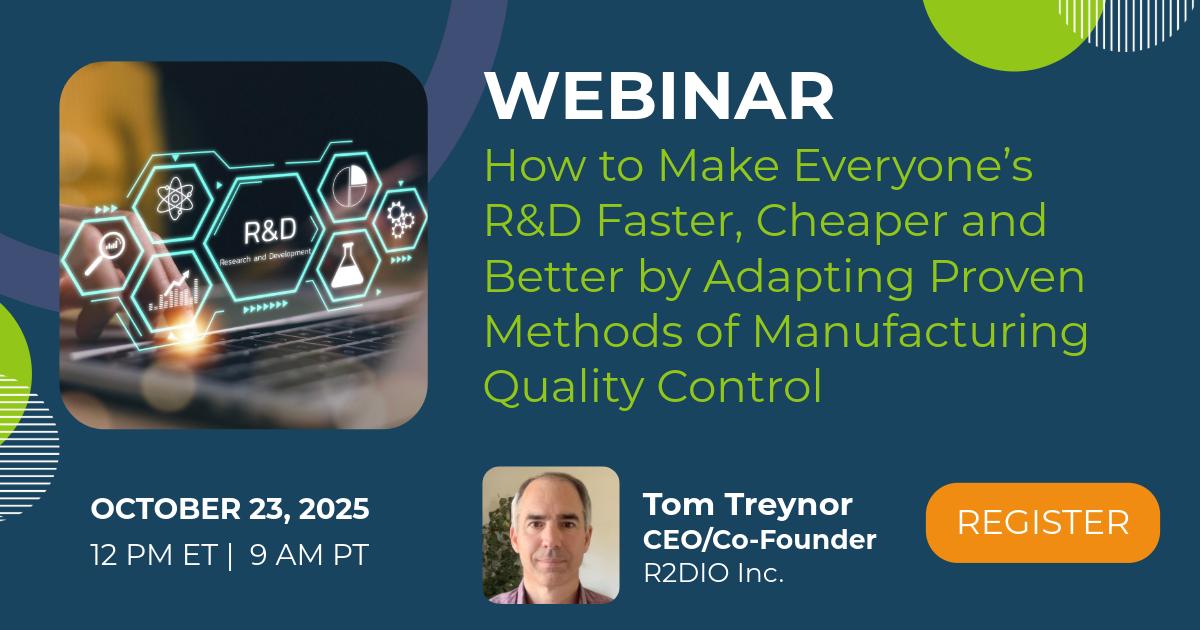
How to Make Everyone’s R&D Faster, Cheaper and Better by Adapting Proven Methods of Manufacturing Quality Control
Webinar Description
The SIMB Education and Outreach Committee present the following webinar as part of their on-going webinar series aimed at highlighting interesting sections of industrial microbiology and biotechnology.
Statistical Process Control (SPC) is a method of quality control that has been described as “a way of thinking that happens to have some tools attached.” Since its invention in 1924, SPC has enabled increasingly complex manufactured goods to become simultaneously less expensive and more reliable. This presentation will illustrate what’s possible when SPC is used to make today’s R&D less expensive and more reliable as well: concentration measurements with Coefficients of Variation < 0.5%; strain performance measurements with CV < 2%; and high-throughput screening methods that predict at-scale performance with root mean square error < 3%.
Without SPC, common statistics and modern AI/ML can grossly underestimate how often data-based decisions are infused with false positive and false negative errors. The costs incurred by these errors are then invisible until a time when they have already been paid by the accumulation of a confusing collection of inconsistent outcomes. SPC can help R&D teams to prevent (and escape) these widespread “Reproducibility Crises” by enabling them to time- and cost-efficiently root out the special causes of non-random variation in their experiments, leaving only the random normal variation that is assumed by their statistical and AI/ML models. SPC-based tools can also be used to inspect the quality of new measurements before they are supplied to decision-making consumers of those data. W. Edwards Deming’s aphorism stating that “A method of measurement does not exist unless the results show statistical control” can be reframed for R&D as “First do Statistical Process Control, then do Statistics and AI/ML.” SIMB is grateful to R2DIO, Inc. for accepting the Committee’s invitation to speak and sponsor this webinar.
Presented By
Tom Treynor – R2DIO, Inc.